DIANA LI
Engineering, Design, Medical Devices & DIY
ROBOT FRAME
Skills: Failure Mode Analysis, Mechanical Analysis, Material Selection, Performing Translations, Process Selection
Software: CES EduPack
In current research, limitations in contemporary robots have sparked an area of research that aims to combine the benefits of rolling and legged locomotion. The robot analyzed in this project takes the form of quadrupedal legged robots that can perform rolling locomotion through the use of cylindrical or oval-shaped bodies. The ability to switch between a walking gait and a rolling configuration will grant them superior mobility over various types of terrain, hence, make them better able to perform the vital tasks required of modern mobile robots such as surveillance and inspection.

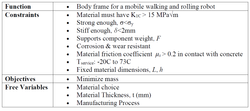
For this design, our goal is to select the best material to reduce the mass of the robot’s body frame upon which the robot will roll. The loading conditions for walking and rolling are shown below, along with the translation developed for this problem set-up.
 |  |
|---|
Material Selection
For material selection, walking and rolling conditions were analyzed with 4 translations: 1) yield strength 2) deflection 3) fracture and 4) fatigue. To analyze results, top-performing materials from all translations were ranked by 1) limiting condition (walking or rolling) 2) limiting factor 3) minimum section thickness and 4) total component mass.
Top-performing materials were evaluated in CES EduPack with the material indices evaluated in each translation. The bottom right is a CES visualization of results with the yield strength material index. In the summarized results displayed below on the right, we found that wrought magnesium alloy will yield the lightest robot frame mass. Wrought magnesium alloy was the best material because of its good performance in deflection and fatigue.
 |  |
|---|
Process Selection
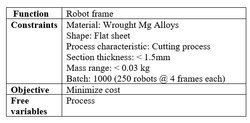
For process selection, we performed a translation based off of attributes from a wrought magnesium alloy robot frame. This translation is outlined in the bottom right, and the best process for reduced cost is sheet stamping. Based on our estimated batch size of 1000, the cost of one individual robot frame component is $17.9. Since the entire robot cost is $1,400, the cost of the robot frame is minuscule (0.01%).
We also recommend additional processes outlined below:
Shaping Secondary: Machining (Drilling)
Electroplating finish for corrosion resistance
Shot peening for hardness and wear resistance
 |  |
|---|